

What Is a Marketer Still Worth?
For most of the history of marketing, intelligence was scarce. A good strategist could see structure where others saw noise. A good researcher could find and connect information others could not. A good copywriter could turn an ordinary thought into language people remembered. A good media specialist understood systems most people could not operate. A good planner could transform fragmented evidence into a coherent recommendation. These capabilities commanded economic value partly because they were difficult to acquire, expensive to deploy and concentrated among relatively few people. AI is now attacking that scarcity. Not all at once, not evenly and certainly not completely, but the direction is increasingly difficult to ignore. In BCG’s 2026 survey of 300 global CMOs, 96% said AI was driving end-to-end transformation of marketing. Yet 42% were still using generative AI primarily as an assistant for isolated tasks, while only roughly one-third had progressed toward more agentic forms of execution. This gap matters because it suggests that much of today’s debate — which model to use, which prompt to write, which tool to buy — belongs to a transitional period rather than the eventual operating model of marketing.
The more consequential question sits further ahead. Imagine that high-quality machine intelligence becomes effectively universal: every marketer, agency, startup and student has access to systems capable of professional-level research, analysis, writing, ideation, production, optimization and orchestration. Whether any particular model becomes literally free is less important than the economic direction: the marginal cost of competent intelligence is falling rapidly. If that continues, access to intelligence eventually stops being an advantage. And marketing faces a much harder question: when intelligence becomes abundant, what remains scarce enough for a marketer to be valuable?
Our answer is unlikely to be execution. It will increasingly be judgment.
The Economic Value Inside Marketing Is Moving
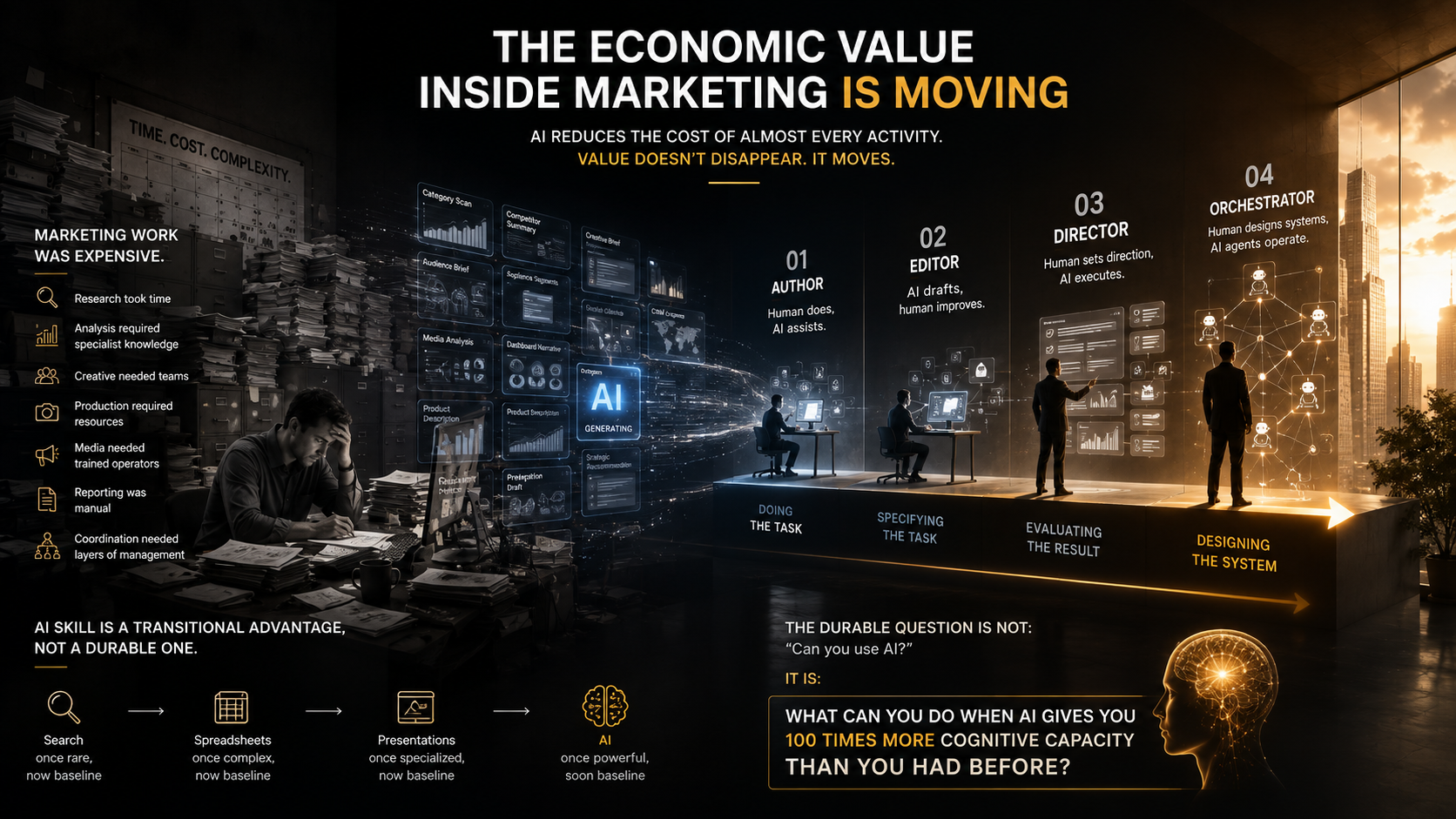 Marketing employs people to transform information into decisions and decisions into market action. Historically, both transformations were expensive. Research required time. Analysis required specialist knowledge. Creative development required teams. Production required resources. Media execution required trained operators. Reporting required manual work. Coordination required layers of management. AI reduces the cost of almost every one of these activities. The implication is not that every marketing job disappears. The more important implication is that the economic value inside the job moves.
Microsoft describes the evolution of human–AI work through four operating modes: Author, Editor, Director and Orchestrator. At the beginning, the human produces the work and AI assists. Then AI creates the first draft and the human improves it. At higher levels, the human defines the objective and delegates increasingly complete tasks. Eventually, the human designs systems in which multiple agents perform work while people intervene around exceptions, ambiguity, judgment and control. The progression points toward a broader shift in professional value: from doing the task, to specifying the task, to evaluating the result, and eventually to designing the system that repeatedly produces the result.
Consider what this means for everyday marketing work. Category scans, competitive summaries, creative briefs, campaign territories, customer segmentation drafts, media analyses, dashboard narratives, social calendars, CRM sequences, product descriptions, presentations, localization and first-pass strategic recommendations are all becoming easier to produce. None becomes worthless, but each becomes less scarce. And markets rarely pay sustained premiums for capabilities that become universally available. This is why “AI skill” itself should not be confused with durable professional advantage. Today, knowing how to use AI well can create substantial leverage, and PwC reports that jobs explicitly requiring AI skills are growing faster and currently command meaningful wage premiums. But that is exactly what we should expect during a technological transition. When a technology is difficult to access or operate, knowing how to use it is valuable. When the technology becomes embedded in ordinary work, operating it becomes baseline literacy. Search followed this pattern. Spreadsheets followed it. Presentation software followed it. AI is likely to follow it too.
The durable question therefore will not be “Can you use AI?” It will be: What can you do when AI gives you 100 times more cognitive capacity than you had before?
From Maker to Decision Architect
The traditional marketing career was built around production. Junior people executed. More experienced people reviewed. Managers coordinated. Directors decided. Senior leaders allocated resources and accepted accountability. AI begins to compress this ladder because increasingly capable systems can perform larger portions of the production and coordination layers. The marketer therefore evolves from Maker → Specialist → AI Director → Orchestrator → Decision Architect. The Maker produces the work. The Specialist produces it with superior expertise. The AI Director defines what needs to be produced and directs machines toward it. The Orchestrator designs workflows across humans, agents, data and systems. The Decision Architect operates one level above the workflow itself: deciding what problem deserves to be solved, what outcome actually matters, what evidence would justify action, which trade-offs are acceptable, what can be delegated, what must remain human, when the system should stop and who owns the consequence.
This is where the profession begins to change fundamentally. Organizations will still need outputs, but producing a plausible output will become progressively easier. What remains difficult is deciding which output deserves to become action. A machine can generate twenty positioning territories; someone must determine which one the brand has permission to own. It can produce fifty scripts; someone must recognize whether any contains an actual idea. It can identify a statistical pattern; someone must determine whether the pattern is causal, consequential or merely interesting. It can recommend reallocating media; someone must ask whether the optimization is generating incremental demand or simply harvesting demand that already existed. It can produce confidence; someone must decide whether that confidence is warranted.
This is why the first durable competency of the future marketer is not prompting. It is problem framing. AI becomes extremely powerful once a problem has been sufficiently specified, which makes specification itself more valuable. Marketing organizations have historically tolerated imprecise objectives — “build awareness,” “engage Gen Z,” “increase brand love,” “create buzz,” “drive conversion” — because large teams could compensate for weak framing through activity. When execution becomes cheap, that inefficiency becomes more visible. An AI system executing a bad brief at extraordinary speed does not create better marketing. It creates bad marketing faster. The future marketer therefore needs to distinguish symptoms from causes, business problems from communication problems, observed correlations from causal mechanisms, customer descriptions from actual decision pressures, and optimization metrics from the underlying business objective.
When execution becomes cheap, solving the wrong problem becomes more expensive.
Judgment Becomes Scarce When Answers Become Abundant
The World Economic Forum continues to rank analytical thinking as the most important core skill among employers, while AI and big data lead the fastest-growing technical skills. At the same time, creative thinking, leadership, systems thinking, resilience and technological literacy are all expected to increase in importance through 2030. This combination is more revealing than a simple story in which technical skills replace human skills. It suggests that the premium is moving toward technical leverage combined with human judgment. PwC’s 2026 Global AI Jobs Barometer reinforces the pattern: skills in the most AI-exposed jobs are changing more than twice as fast as in the least exposed jobs, while highly AI-exposed entry-level roles are substantially more likely to demand capabilities traditionally associated with seniority, including judgment and leadership.
The reason is straightforward. AI reduces the value of producing a plausible answer while increasing the value of distinguishing a plausible answer from a good one. The future marketer therefore needs fewer answers than before and a stronger ability to reject answers. This is judgment: knowing which hypothesis deserves testing, which evidence is sufficient, which result is noise, which trade-off is acceptable, which recommendation deserves capital and which polished piece of work should simply be killed.
Closely related to judgment is taste, a capability often treated too narrowly as an aesthetic preference belonging to creative departments. Taste is better understood as an advanced selection system: the ability to recognize meaningful differences in quality before those differences can always be completely formalized. When a creative team can produce three ideas, generation is the bottleneck. When it can produce three thousand, selection becomes the bottleneck. The same principle extends beyond creative work. There is taste in strategy, evidence, customer understanding, brand behavior and business models. A strong marketer recognizes what is generic despite appearing polished, what is novel but strategically irrelevant, what is culturally interesting but wrong for the brand, what appears original because its references are unfamiliar, and what is simple because it is powerful rather than empty. AI increases the number of possibilities. It does not remove the need to decide which possibilities deserve reality.
As Machine Intelligence Improves, Contact With Reality Becomes More Valuable
AI can process extraordinary amounts of information. That is not the same as being close to reality. Marketing ultimately concerns people making decisions inside actual contexts, and people do not behave as abstract segments. They operate through habits, incentives, identity, fear, social pressure, constraints, imperfect information and local circumstances. The marketer who spends all day interrogating increasingly sophisticated synthetic summaries risks becoming increasingly detached from the thing marketing exists to understand.
This creates an interesting reversal. As machine intelligence becomes stronger, first-hand contact with reality becomes more valuable. Talking to customers, watching purchase behavior, entering stores, listening to dealers, observing communities, understanding what salespeople know, seeing what breaks during service delivery and recognizing cultural details that never enter the dashboard become sources of differentiated context. AI dramatically increases our ability to process observations; it does not guarantee that the observations entering the system are the right ones. The strongest future marketer may therefore combine machine-scale cognition with unusually grounded human observation.
The same principle applies to evidence. Generative AI makes hypotheses cheap, which raises the value of knowing which hypotheses deserve testing. Marketing has historically tolerated weak evidence: engagement presented as preference, attribution presented as causation, recall presented as purchase intent, clicks presented as incremental demand, correlation presented as explanation. AI can make these mistakes more dangerous because it can generate convincing narratives around weak evidence. The relevant question is no longer simply, “What does the data say?” It becomes: What claim does this evidence actually allow us to make? That requires stronger understanding of measurement, baselines, counterfactuals, confounding, sample validity, incremental effects and decision thresholds. When information is abundant, information becomes cheap. What remains expensive is discriminating evidence — evidence strong enough to change what an organization should do.
The Marketer Will Increasingly Manage Machine Capacity
Another competency therefore rises quickly: orchestration. This is not prompt engineering. Orchestration means turning a business objective into an operating system. What should the agent know? What data can it access? Which decisions can it make? Which tasks should run continuously? Which outputs require approval? What quality threshold must be met? How should different agents coordinate? What happens when they disagree? What should trigger escalation? How should context be preserved? How is performance measured? What is the kill condition?
As marketing moves toward these systems, the profession begins to resemble product management, operations and systems design. The marketer no longer manages only campaigns. They increasingly manage marketing intelligence capacity. BCG’s 2026 work points in this direction: leading CMOs are moving beyond isolated AI tools toward orchestration, data foundations, brand intelligence layers and redesigned operating models. The organization itself starts to shift from collections of channel specialists toward smaller AI-enabled teams organized around broader business objectives and customer problems.
Yet greater machine capability creates another requirement that cannot simply be automated away: accountability. A model may be capable of producing an action, but a company still needs someone with the authority to approve it and responsibility for its consequences. Who approved the claim? Who accepted the reputational risk? Who decided a customer should receive that offer? Who authorized the agent to change a recommendation? Who determined that the optimization objective was commercially acceptable? Who explains the decision to the CEO when it fails? Capability is not authority, and authority is not accountability. As AI takes on more execution, human value increasingly concentrates where organizations cannot outsource responsibility.
The future senior marketer may therefore be paid less for knowing how every piece of work gets produced and more for being able to say:
I understand this decision well enough to own it.
AI Creates a Problem for the Marketing Career Ladder
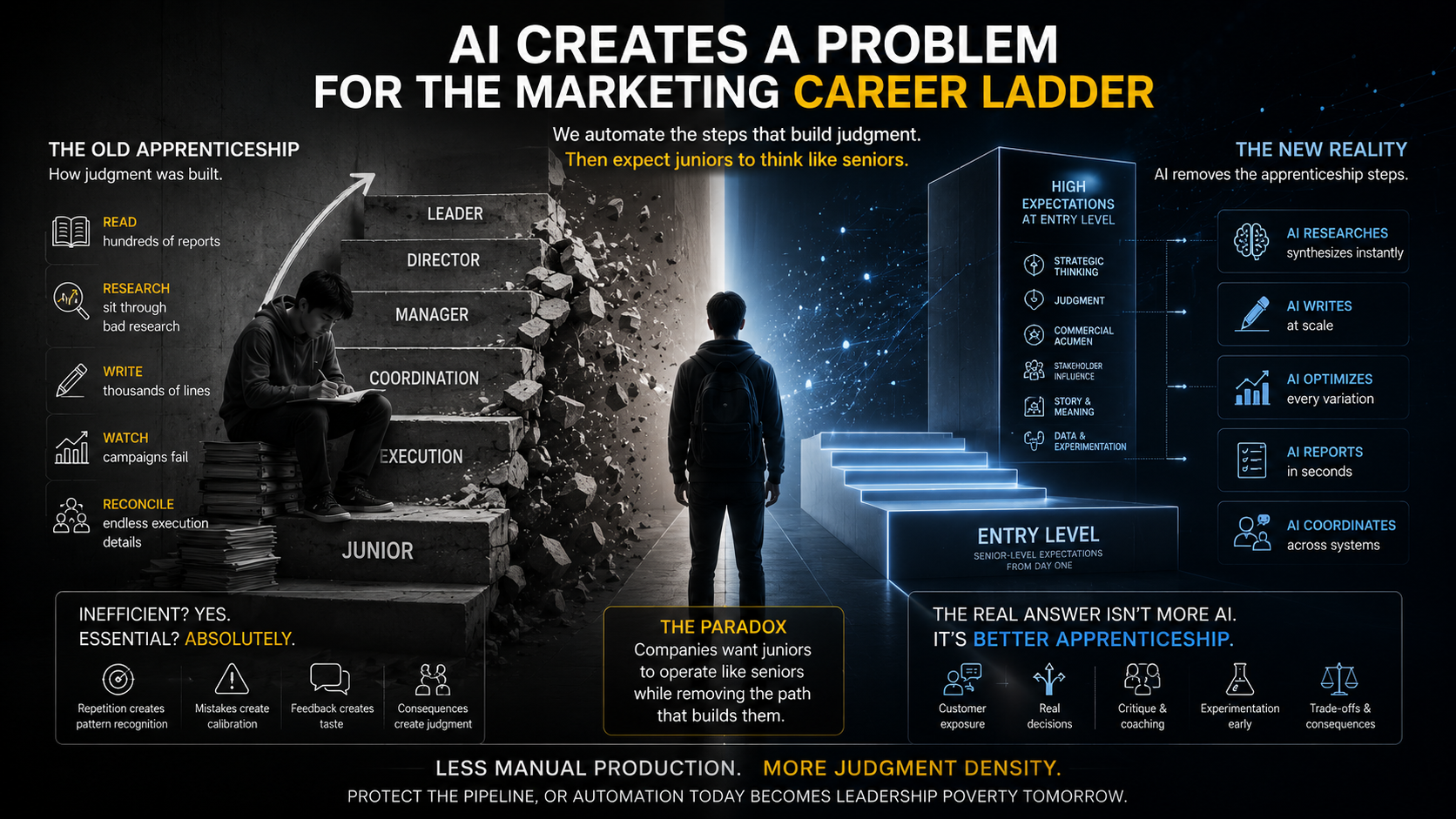 There is, however, a structural problem hidden inside this transition. Expert judgment is normally built through low-level work. A junior strategist reads hundreds of reports. A planner sits through bad research. A copywriter writes thousands of lines. A media buyer watches campaigns fail. A brand manager reconciles endless executional details. Much of this work is inefficient, but it is also how tacit knowledge develops. Repetition creates pattern recognition. Mistakes create calibration. Feedback creates taste. Exposure to consequences creates judgment.
AI threatens to remove exactly these apprenticeship tasks. PwC’s finding that highly AI-exposed entry-level roles increasingly demand capabilities traditionally associated with more senior workers should therefore be taken seriously. It creates a paradox: companies increasingly want juniors to operate like seniors while automating the work through which juniors historically became seniors.
This is not merely a reskilling problem. It is a capability-development problem. Marketing organizations will need to deliberately recreate apprenticeship under different conditions. Junior talent may spend less time manually producing basic work, but it will need earlier exposure to customers, decisions, critique, experimentation, commercial trade-offs and consequences. Instead of asking a junior to write fifty headlines because someone needs fifty headlines, a future organization may ask them to evaluate fifty AI-generated headlines, explain why forty-nine fail, defend the surviving idea and observe what happens when it enters the market. The amount of manual production falls. The density of judgment-building experience must rise.
Companies that fail to solve this may achieve impressive short-term productivity while quietly destroying their future leadership pipeline.
Creative Production and Creative Value Will Separate
Generative AI is already eroding production scarcity. This matters because creative industries have historically bundled idea creation, articulation, craft, production and adaptation together. AI increasingly separates them. A marketer can generate an image without being a photographer. A strategist can visualize a film concept without assembling a production team. A junior can produce competent scripts. One person can generate hundreds of content variations.
This does not eliminate creative value. It exposes where creative value actually resides. If every company can generate polished imagery, polished imagery stops being sufficient. If every team can generate one hundred ideas, having one hundred ideas stops being an advantage. If everyone can personalize, personalization becomes infrastructure. Creative professionals therefore need to move upstream toward finding tension, recognizing contradiction, reframing categories, understanding cultural permission, creating organizing ideas and deciding what should never be produced in the first place. AI democratizes production much faster than it democratizes discernment.
Performance marketing faces a parallel transition. Bidding, budget allocation, variant generation, audience optimization, pacing, reporting, pattern detection and routine experimentation are highly structured tasks with frequent feedback — exactly the type of environment where machine execution can become increasingly powerful. The human performance marketer therefore moves from asking “How should we optimize?” toward “What should we optimize for?” A system can maximize ROAS, but should it? What if apparent ROAS comes largely from customers who would have purchased anyway? What if short-term conversion reduces future price tolerance? What if an algorithm systematically avoids creating new demand because existing customers convert more cheaply? Optimization can find efficient paths toward an objective. It cannot determine whether the objective itself deserves to govern the business.
Brand management experiences the same shift from another direction. When AI enables thousands of assets, millions of personalized interactions, creator interpretations, commerce descriptions and potentially autonomous brand behavior, no brand team can manually approve every expression. Governance therefore has to move deeper: from controlling logos, copy and individual messages toward governing brand truth, product truth, meaning, character, evidence, claim boundaries, cultural permission and decision rules. The Brand Manager evolves from guardian of consistency toward architect of a meaning system. The organization cannot specify every sentence the brand will ever say. It must specify the principles from which appropriate behavior can emerge.
Marketing Organizations May Become Thinner. The Human Roles Inside Them Will Become Heavier.
The exact employment effect remains uncertain. The World Economic Forum estimates that 22% of jobs globally will experience disruption by 2030, with 170 million roles created and 92 million displaced, producing a net increase of 78 million jobs. It also expects nearly 40% of required job skills to change. Those are economy-wide estimates, not a forecast of marketing headcount, and it would be irresponsible to convert them directly into one. What current marketing evidence does suggest is transformation rather than simple removal. BCG’s work shows leading organizations deploying AI across strategy, insights, briefing, content, activation and optimization while beginning to redesign teams around broader objectives rather than merely attaching new tools to existing channel structures.
The likely consequence is therefore not simply “fewer marketers.” It is fewer people whose primary value comes from routine execution and coordination, and greater value concentrated around people who own problems, understand customers, design systems, interpret evidence, set objectives, exercise taste, manage exceptions and accept responsibility. Marketing organizations may become thinner, but the cognitive weight carried by each human role increases.
This is why “human versus AI” is the wrong frame. A more useful question is whether AI makes a particular form of expertise more valuable or less necessary. If most of someone’s contribution consists of execution that machines can increasingly reproduce, their economic position weakens. If their contribution lies in framing, judgment, context, evidence, orchestration and accountability, AI may dramatically increase their leverage. Both people will use AI. The difference is what remains when AI removes the parts of the job that were never truly scarce.
When Intelligence Becomes Free
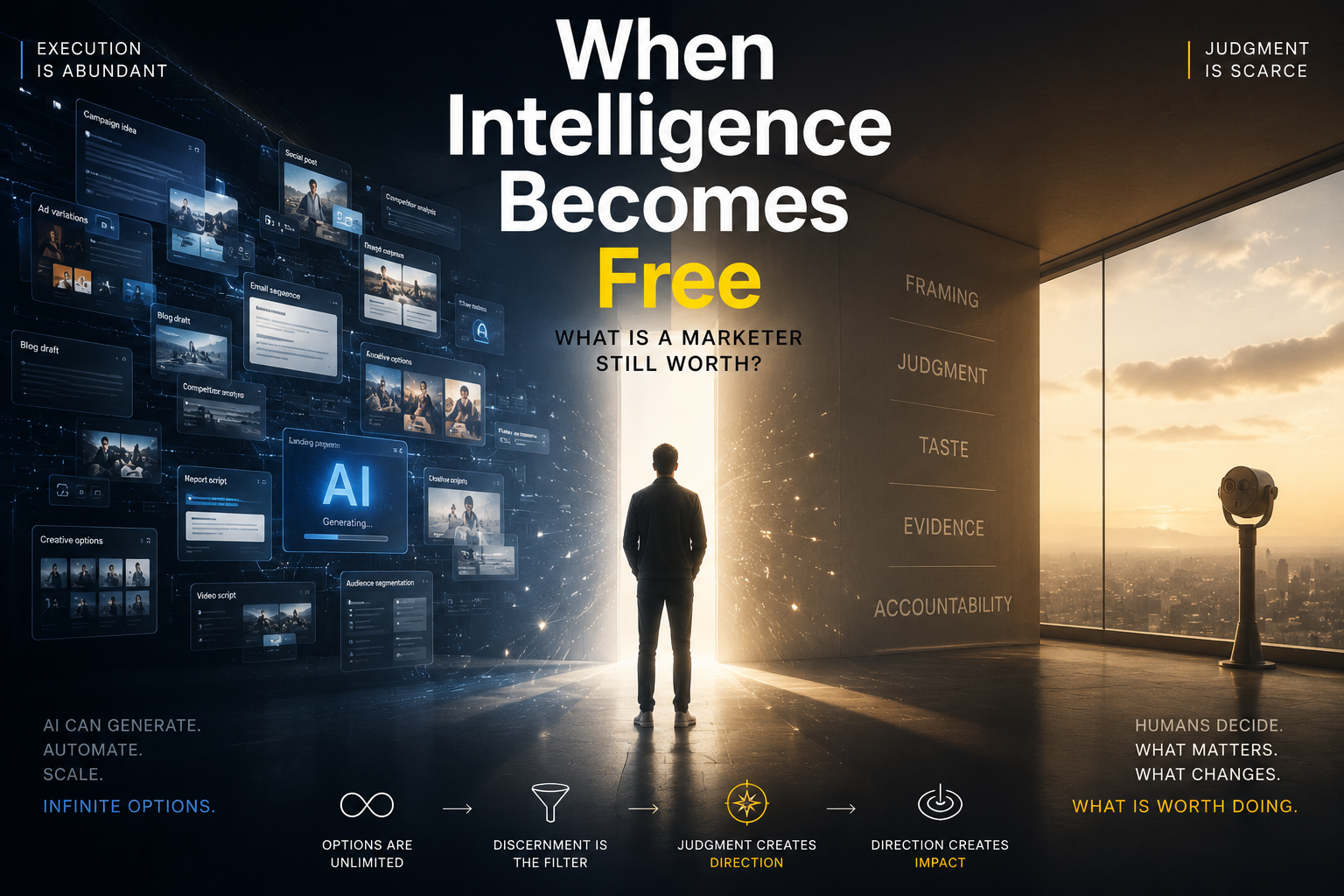 Now take the argument to its logical extreme. Assume frontier-quality intelligence eventually becomes effectively free. Every student has it. Every founder has it. Every small business has it. Every marketer has it. Every competitor has it. Every agency has it. At that point, intelligence becomes infrastructure, and infrastructure does not create differentiation simply because one has access to it.
Advantage moves elsewhere: toward proprietary context, first-hand observation, trusted relationships, customer access, distribution, unique data, real product superiority, institutional authority, taste, courage and the ability to decide under uncertainty. The same applies to individuals. The question first moves from “What can you produce?” to “What can you make AI produce?” But eventually even that question loses discriminatory power. The deeper question becomes: What do you know deserves to be done, and are you capable of owning the consequence?
That may be the defining competency of the marketer after intelligence becomes abundant. Not intelligence alone. Not creativity alone. Not technical literacy alone. But the ability to turn abundant intelligence into scarce judgment.
The future marketer will still need to understand brands, customers, media, culture, commerce and technology, but those domains increasingly become inputs rather than professional identities. The profession itself moves upward: from production to direction, from direction to orchestration, from orchestration to judgment, from answers to decisions, and from activity to consequence.
AI will make execution abundant. Judgment becomes scarce.
The future marketer will not be paid primarily to produce the work. They will be paid to define it, direct it, evaluate it and own it.
And when intelligence becomes available to everyone, the strongest advantage will no longer belong to the person with the most answers.
It will belong to the person who understands what deserves a decision.
— IICS